

Everything posted by Sparepart
-
New member - brake servo question
I'm not an expert. As I see it ABS or not ABS is a red herring here because both have a master cylinder operated by a brake pedal (and servo) the pressure generated by the master cylinder may or may not then go to an ABS component which can regulate the pressure to individual wheels to avoid lockup. The Sierra master cylinder did have 3 outlets, one for rear and two for front, however the two front ones were driven by the same piston, I know because I took it apart, I assume that it had two outlets because it's cheaper than having a single outlet and then a separate splitter to go R or L at front of car, whereas the single rear outlet means a single pipe to the back and then a splitter near the rear subframe. One annoying thing about the Sierra master cylinder apart from replacement cost is that the outlets are on the engine side, so the pipes emerge right above the heat of the exhaust manifold. (by the way this is the same on LHD sierras, so if buying a replacement a LHD version is worth considering and might be more available) Anyway, before you go to sleep reading this (I am), 2 or three outlets doesn't matter to me, what matters is that the master cylinder has two pistons that can provide a DUAL circuit system with an output for each. I am going for a front back split for the circuits, but a diagonal arrangement could be possible. The icing on the cake about the KA MC is that the outlets are on the other side from the exhaust manifold which means the pipes are far less exposed to heat.
-
New member - brake servo question
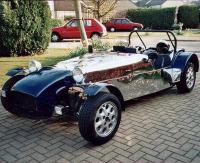
I'm rebuilding an Exmo. The original brake master cylinder from a Sierra is all seized up, replacement is expensive. So I have gone down the Ford KA path. I have purchased a complete unit with reservoir and servo, not new, there are many on offer from breakers. Here is a picture of what I have bought. This part is also common with models of Fiat Panda. Here are some old links to eBay ads. https://www.ebay.co.uk/itm/226996062974 https://www.ebay.co.uk/itm/256831165194 https://www.ebay.co.uk/itm/226368975525 https://www.ebay.co.uk/itm/157493628002 You will find I think that the common part number is 51866500. I have discarded the servo, as both the Sierra servo and the Ford Ka servo get too close to the exhaust manifold. Obviously I have had to make a new push rod from the pedal box, and clip to hold the rod in the top of the brake pedal. This rod is threaded at the pedal end so that I can adjust it. I have only just got the car mobile on a short driveway, it does stop, however it feels like I am going to need quite a lot of force on the pedal compared with when servo assisted. The other challenge is the height of the fluid reservoir. As it is I cannot place the bonnet on the car because the reservoir filler tube is too high. I need to get the car up to a good speed somewhere to try the brakes for real. If they are good enough then I will fit a remote reservoir. If the car won't stop without needing me to really stamp on the brakes then I'll.....welll... back to the drawing board I guess. Note the Ka MC has two output points. On the Ka these are connected to each diagonal slave cylinder, Front right and Rear left, Front left and rear Right so there is no bias in the pressure. I am using the two outputs as Front pair and Rear pair. This might sound iffey but even with the Sierra MC I had discarded the bias valve and was not getting a rear lockup on hard breaking. Fingers crossed on this.
-
Welcome to New Members
Bienvenue Xavier. Mon français est limité, je vous écris donc par l'intermédiaire d'un traducteur. La maquette de Robin Hood que vous avez acquise est en réalité un modèle « Robin Hood EXMO ». Il a été modifié par rapport au modèle original afin d'y intégrer des ailes de moto. Vous trouverez des informations spécifiques sur ce modèle dans une section dédiée de ce site web, à ce lien. https://models.rhocar.org/exmo/
-
Please help 2.0 pinto won’t start
Apologies for this silly question, but it's something that I'd like to be sure about. I used good old Google and asked the AI the following question. "what engines were fitted to cmc gazelle kit cars" The result, that Ford Pinto cars were used as donors for the kit threw up the possibility that there might be confusion over the use of the word "Pinto". The Ford Pinto CAR as sold in the USA used a Ford "Lima" engine (2.3L) while in Europe we never saw a Ford Pinto car but did have Ford models equipped with a different SOHC engine which is known as a Ford Pinto engine (max 2.0L).... in the very first part of this thread you do say Ford Pinto 2.0L and also write about importing parts, so I guess we are all talking about the European engine, that is why this is a silly question....... but I ask just in case.
-
Please help 2.0 pinto won’t start
So, you appear to have the belt fitted okay if the pointer on the cam is opposite the dot on the head when the crank pulley marker is opposite the big groove on the crank pulley. This is the almost the exact time that a spark is needed at number 1 cylinder. So next step is to get the alignments as above, then check where the rotor arm is at the distributor. It should be in a position right at the bottom of the HT lead that goes to number 1 cylinder. (No 1 as seen from front of engine) if this is not the case then you need to pull out the distributor (you say you already swapped it once) and turn the rotor arm to the right position (probably also coincides with the dot you mention) and reinsert the distributor. This might not be simple, because the gear at the end of the shaft is helical, so the rotor arm will turn as you insert it. You have to allow for this. Also its good to have the body of the distributor half way through its possible arc of motion, because if the car does fire up you will need to rotate the distributor body to complete the tuning. Then you need to check that the HT leads are in the correct order. Assuming the rotor arm is under HT lead to No 1 cylinder the next cylinder to need a spark is number 3 cylinder, the arm moves clockwise, this should be the next lead, etc, The firing order is 1,3,4,2. So with the distributor positioned as explained, with the crank and cam positioned as explained, and the HT leads in the order explained, you should have a fair chance of starting the engine, as long as there is fuel in the inlets and spark from the coil. When it fires up, your actions are not over, because it might refuse to run continuously, might back fire, might blow up through carb etc. In this case you will need to rotate the distributor body, usualy in an anti clockwise direction, to advance the spark a little. In any event probably shouldn't need to make wild rotations of the body, try one direction or another a little at a time to see if running sounds better. Good luck.
-
Maximum axle weight
Help us by letting us know which model Robin Hood you have. ? https://nw.rhocar.org/identification.htm
-
Please help 2.0 pinto won’t start
Paying that much for a distributor and coil, I am guessing the ignition module is built into the distributor. I was interested in the way that you set up the timing when you changed the belt, I would have never thought of that. Anyway, regardless of the current problem, it might be worth checking the timing in the way described in the workshop manual, just to check, because we are talking about a few degrees of miss timing making a big difference. It is quite simple to check the timing by first getting a spanner on the big bolt that keeps the crankshaft pulley on, use this to turn the engine (keep ignition off!). Turn the bolt/pulley clockwise until the timing grooves on the pulley reach the static marker on the engine block near the pulley LHS top as looked at from in front. Then look at the camshaft sprocket at the top of the engine to see if the little pointer thats visible between spokes of the sprocket is in line with the small static hole on the head. If pointer is no where near the hole then the engine is at TDC for the exhaust stroke at number 1 cylinder..... so continue to turn the engine until the grooves on the crankshaft pulley come round again, now you should see the camshaft pointer is close to the hole.Either way adjust the crankshaft until the camshaft pointer is exactly by the hole. Now look where the crankshaft sprocket markers are in relation to the static marker. At exact TDC for compression stroke on number one cylinder the pointer should be at the leftmost, biggest of the grooves. If it is not then you would need to remove the belt and turn the engine to the exact position and refit the belt. Here below is a link to a YouTube showing how to find the marks. https://www.youtube.com/watch?v=T5CPlM-G0t8 Oh,yes, you could remove the plugs to make turning easier.
-
Starter motor ID
I have a suggestion. I looked on line for adverts, and found a candidate on eBay. https://www.ebay.co.uk/itm/264381686799 Have a good look at the photos in the advert, and see if they match your starter, to me it looks very similar to yours. The point is that these images include the ford part number 91BB-11000-BA. Perhaps then you can find the correct brushes (or whole brush plate) using this. ?
-
Help needed with Ford Puma
I just Googled this, it's fantastic, no wonder it cost so much. Somewhere there's a 48v rechargeable battery, this is not just an alternator, it's also a starter, and also used to boost the engine when accelerating... needs water for cooling. I wonder if it could be retro fitted to a Pinto ? Hybrid Kit Car ? ..... On e bay the pukka ford part costs 1.5K probably as much as my car is worth. :-)
-
Help needed with Ford Puma
Procure an aerosol can of silicone lubricant, one with a thin long tube as a means of delivery. Chose one of the bearings that might be the culprit, carefully manoeuvre the end of the tube so as to deliver a short spray of lubricant into the heart of the bearing. Start the engine and listen for the noise. If it is markedly diminished you will have found the source, otherwise proceed with alacrity to another possible bearing and repeat the same procedure, not forgetting the front bearing of the alternator. If you do manage to locate the source using this method then this will not mean that the problem is cured, it will return as the lubricating properties of the silicone diminish.
-
GBS Zero Rescue
Just to dot the Ts and cross the Is, you probably already know that the top cover has a breather hole, its in the top of the hemispherical bulge, important to check it's not blocked, box warms up in use, blocked breather causes pressure increase in box, oil squirts out from the seals. I assume the new alloy one also has a breather of some sort.
-
GBS Zero Rescue
Just to be clear. The only plug in the gearbox side is the filler plug. It doesn't have a drain plug, which you mention. The gearbox oil is at the right level when, on level ground, the oil just reaches the filler plug. Most people fill until it starts to overflow. In your description of removing the top cover and filling the box with oil I have an image of the level literally reaching the top of the box, that is way above the filler plug hole. Please tell me I am wrong.
-
GBS Zero Rescue
Well, yes and no, If you fill the gearbox before you put in the Engine and Gearbox in as one unit, I found it was hard to stop the gearbox oil from pouring out of the rear box oil seal hole, because there is no prop shaft to seal it. I did find an old aerosol cap that fitted the hole and taped it up, but after all the messing about with the hoist and tapping the end on engine bay bits a few times it fell out and drenched the area with gearbox oil.
-
GBS Zero Rescue
-
Pinto 205 noise
Also I found this topic in our vast wealth of archived threads. Well worth you searching when you have a problem that might have come up before. https://www.rhocar.org/index.php?/forums/topic/43978-pinto-20-engine-knocking/
-
Pinto 205 noise
A few questions. Did this noise arrive suddenly ? or did it arrive gradually over a while?. Does depressing the clutch alter the sound.? Does the sound alter when there is load on the engine.? For example put handbrake on, depress clutch, select 5th gear, rev a bit and then slow the engine by releasing the clutch very gently, this will place load on the big end and little end bearings, also increases pressure in cylinders, does the sound alter? does more smoke come out of the exhaust. The above can obviously be carried out on the road by accelerating from stationary, but choose a quiet road. Is the compression pressure in all cylinders the same ? What is it ? When you drove this car, before the noise started, can you remember what sort of RPM you went up to ? How many miles has the engine done since new/rebuild ? Just questions I am afraid.
-
Mt75 Gearbox
Personally, I've no experience on this, just been web browsing and saw your post in other forum and reply which was not much help. I also saw someone else's experience with this gear lever https://forum.retro-rides.org/thread/129594/mt75-gearstick-removal which you might have read,...... not a positive story. A whole lever replacement might be needed, and it doesn't look cheap. I did see this as an option you might consider https://kitspares.co.uk/products/mt75-quick-shift although it probably doesn't have the protection for engaging reverse.
-
Starter motor confusion
Another check that you might have already made:- The pinion has same number of teeth (yes you wrote) Diameter of pinion same, width of pinion same, distance of centre of pinion from the starter mating surface when pinion is at it's outward position at end of shaft, same.
-
Starter motor confusion
I think we can assume Will has a pre engaging starter (bottom pic). In the description he writes "ran additional earths/positive leads to the starter with no improvement", Now we can ask does this include checking the wiring from the starter switch to the solenoid. If some resistance has built up in the connections of this wire to the solenoid, loose wire or corrosion etc. then what could be happening is that there is enough power arriving at the solenoid to cause it to push the pinion out and close the main starter switch. Then the motor starts and uses a BIG current drain from the battery which is enough to reduce the voltage in the solenoid circuit because of it's higher resistance, this means not enough power to the solenoid to resist the tension of the return spring, the actuator retreats and the main starter switch opens, but now voltage returns to the solenoid and it reactivates, this cycle proceeds at a frequency that depends on the resistance in the solenoid circuit and the tension of the spring. In some cases it results in a rapid clicking, others a higher frequency partial engagement. Just a possibility, that you most likely already checked.
-
Starter motor confusion
Also, I'd add that the inertial starters usually have a "remote" relay, i.e. not piggybacked on top of the starter itself so the inertia one is different looking, no shroud around the business end. Will says "the pinion on both starters looks the same" which suggests that the new starter type is the same as the old, because the pre-engaging and inertial look quite different, a picture of both for us to compare would help.
-
Hola a todos desde España
You have done well to modify the car that you bought, and your lightweight aluminium with the air deflectors looks great and is strong enough to support the rear view mirrors. I am sure that you can already understand that to fit a screen you will need two very secure pillars, one per side, in order to hold the screen and screen frame as shown in the Kitspares kit. The one in the Kitspares kit are made of steel and are flat and need to be shaped to fit the curve of the scuttle side. So as I see it, you have a choice, either fit the windscreen to the bonnet and have the whole bonnet hinge up at the scuttle, or cut a strip from the bonnet to fit along the top and sides of the scuttle and fit the pillars through the bonnet to the frame of the car. (this is what most builders do). Perhaps the two piece bonnet that came with the kit was the original stainless steel bonnet that came with the 2B kit. Here is a link to the build video https://www.youtube.com/watch?v=DNA1Zs8jY_I look at about 4 hours and 20 minutes into the video and see the 2b bonnet being put together. This was used as a hinged bonnet and not very pretty.
-
Hola a todos desde España
If its a 2b then the bonnet should hinge at the back and any windscreen would tilt back when the bonnet is lifted. https://kitspares.co.uk/products/windscreen-set-robin-hood-2b Anyway the link above is a way of getting the needed bits, from the photos, with the big air filter and air deflectors etc. it looks like the bonnet is not fitted to swivel up, so you might have to return to the "jaw opening" fitment to get the W/S kit to work. Possibly cutting some of the rear end of the bonnet off and fixing it permanently to the bulkhead might work. Most people use a windscreen wiper mechanism from British Leyland/BMC etc as fitted to first Minis and Austin and Morris cars.
-
Electric ignition for 2.0l Pinto
Merry Christmas, I was not advocating a change of carbs , you asked about other peoples experience so I gave you mine. I think that if you do use the older ford ignition module you might then have to use a distributor that matches. A standalone distributor that has the contacts replaced by electronics like the Accuspark (other systems are available) possibly makes it easier to buy a brand new item at a reasonable cost. A change of coil or leads is not mandatory.
-
Speedo & Mileage Help
Just Google "is a mileometer a legal requirement uk" and you will see that it is not. So no problem with MOT test, the mileage is recorded but that is all, if there were no mileometer (odometer) it would not fail the MOT. The Speedometer of course is a requirement an must work, and this instrument nearly always includes the odometer so the MOT tester will record whatever the reading is at the time of the test. What IS illegal is for anyone to misrepresent the true mileage of a vehicle at any time. This is mostly during the sale of a vehicle but also would be an issue if an insurance policy was priced on a limited mileage, as far as I can see this could be a minefield for we kit car owners and you are very wise to raise the topic with your insurer. It would be nice if you could update us with what they say, I'll be looking for insurance in the spring.
-
Electric ignition for 2.0l Pinto
My experience, originally I used the donor Ford Sierra electronic ignition, a matched triplet of Hall Effect distributor (no points), ESC II ignition module, and the Weber 32/34 DFTH carb, the one with the ESC II controlled stepper motor. At first it worked fine, but then gradually it got harder and harder to get it to idle nicely, you could adjust the fuel mixture but the XXX ESC II kept altering the idle speed, sometimes it would get into a race condition, revving up then slowing down sometimes so low that it would stall. So when I rebuilt, I dumped all three of these along with several pounds of engine bay wiring loom and relays etc. I fitted a Weber 32/34 DMTL (kit cost £440) and an Accuspark Stealth ignition kit (New coil, Distributor, leads, plugs, £114). This works very well, simple and predictable, and I now have a good old fashioned choke cable and nob to pull. There is nothing like having to pull a nob on a cold morning, give it a half twist and it stays out.